Southeast Asia
All Resource ID
Region Home


Contact IPNI


Oil Palm Portal


Oil Palm Discussion Forum


Maize


Rice


Regional Staff


Projects


Books and Publications


Software and Tools


Information Services


Site Index


Thomas Oberthür
Director, Southeast Asia Program

Bio/Contact Information

The Southeast Asia Program of IPNI
Agricultural production in Southeast Asia will further intensify and diversify to keep up with the rising demand of a growing population that is predicted to increase by 140 million in the next 20 years. The necessity for intensification offers substantial opportunities for farmers to introduce profitable, sustainable and environmentally sound strategies that are tailored to site-specific conditions as the need for purchased inputs increase.

The Southeast Asia Program of IPNI is well positioned in the region through joint collaborative projects on the development and dissemination of novel site-specific nutrient management approaches in rice, maize, and oil palm in lowland and upland areas of Indonesia, Malaysia, the Philippines, and Vietnam. Projects that cut across crops include work on soil-related constraints to increasing productivity.

It is our vision that farmers achieve increased profitability, food security, and environmental sustainability through the appropriate use of fertilizer nutrients considering interactions with other management practices. It is our objective to realize public-private partnerships in the promotion of improved, benefit enhancing nutrient and crop management practices through research and extension.
What's New
News - Latest issue of SEAP Quarterly Newsletter
View the latest information on recent activities of our program and selected news on regional developments.
Software and Tools - Nutrient Expert for Hybrid Maize
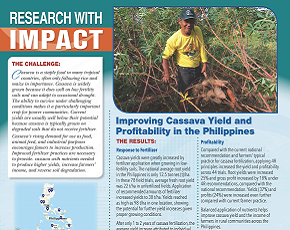
Many countries in Asia have started replacing existing blanket fertilizer recommendations for vast areas with rice, maize, or wheat with more site-specific guidelines adapted to local needs. A key challenge faced by the local extension agencies remains the complex nature of factors influencing nutrient requirements.

The Nutrient Expert for Hybrid Maize is a new, computer-based decision support tool developed to assist local experts to quickly formulate fertilizer guidelines for tropical hybrid maize based on the principles of site-specific nutrient management (SSNM). This software allows scientists and extension experts to jointly develop novel nutrient management strategies for evaluation.

Learn more


Maize - Site Specific Nutrient Management for Favorable Tropical Environments
More than 120 on-farm experiments with hybrid maize were conducted during 2004-2008 at 19 key production sites in Indonesia, the Philippines, and Vietnam to develop and evaluate a new site-specific nutrient management approach for Asia.

The SSNM concept has been simplified and is now ready for wider-scale, participatory evaluation in partnership with farmers.

Learn more

Publications - IPNI Pocket Guides on Oil Palm Now Available in Bahasa Indonesia
The first edition of the IPNI pocket guide series on Nursery, Immature, and Mature published 10 years ago in English language quickly became popular among planters as a generic, high quality, and widely applicable reference to best management practices in oil palm. The guides have been high in demand ever since with more than 4,500 copies sold and distributed to date. It is much overdue that we offer the pocket guide series in Bahasa Indonesia to make this ‘ready reference’ more widely available to field personnel.

Learn more


Software and Tools - Nutrient Manager for Rice
Nutrient Manager for Rice is a new, user-friendly computer-based decision support tool enabling extension agents to quickly formulate fertilizer guidelines for specific fields or rice-growing areas. This tool only requires information that can be easily provided by a farmer or a local expert. After answering a few key questions, a farmer can get a fertilizer guideline tailored to his rice variety and growing conditions. The guidelines generated by this tool are consistent with the scientific principles of Site-Specific Nutrient Management (SSNM) for rice developed by the International Rice Research Institute (IRRI), and will help a farmer increase his yield and profit by applying the right amount of fertilizer at the right time.

Learn more


Publications Concepts and Technical Information News
Books and Publications
Books and Publications Order Form
SEAP articles in Better Crops
Software and Tools
Soil Fertility
Fertilizers
Economics
SEAP Quarterly Newsletter Archive
SEAP Newsletters 2007-2008 Archive
Field-specific potassium and phosphorus balances and fertilizer requirements for irrigated rice-based cropping systems


This article published recently in the Plant and Soil Journal, discusses how fertilizer K and P requirements for rice can be determined with site-specific nutrient management (SSNM) using estimated target yield, nutrient balances, and yield gains from added nutrient.

Read Full Story

Estimating maize nutrient uptake requirements


A collaborative paper by scientists from the University of Nebraska-Lincoln, the IPNI Southeast Asia Program, and the International Rice Research Institute published in Field Crops Research discusses the development of a generic QUEFTS model and a simpler, spherical model on grain yield-nutrient uptake relations in maize across a wide range of maize environments and grain yield levels.

Read Full Story

Google SSNM on Google Books


Use Google Books (http://books.google.com) to search for full-text versions of publications on SSNM.

Learn more


Economics - Fertilizer Use & Profit

As fertilizer prices increase, farmers and policy makers might consider reductions in fertilizer use. But, crop yield is directly related to amount of nutrient taken up by a crop. At some point, less fertilizer use means lower crop yield and less profit for farmers. How much fertilizer use is just right for high profit?

Learn more

Fertilizers - Organic vs Inorganic


Do organic amendments improve yield trends and profitability in intensive rice systems? Some conclusions emerged after analyzing yield trends of 25 long-term experiments (LTE) with rice-rice (R-R) and rice-wheat (R-W) systems across a wide geographical range in Asia.

Learn more

New Oil Palm Discussion Forum


Oil palm growers are often working in remote places with limited access to information. However, more and more plantations are establishing internet connections via satellite at their estates which offers tremendous opportunities for IPNI to better serve this specific audience.

Learn more